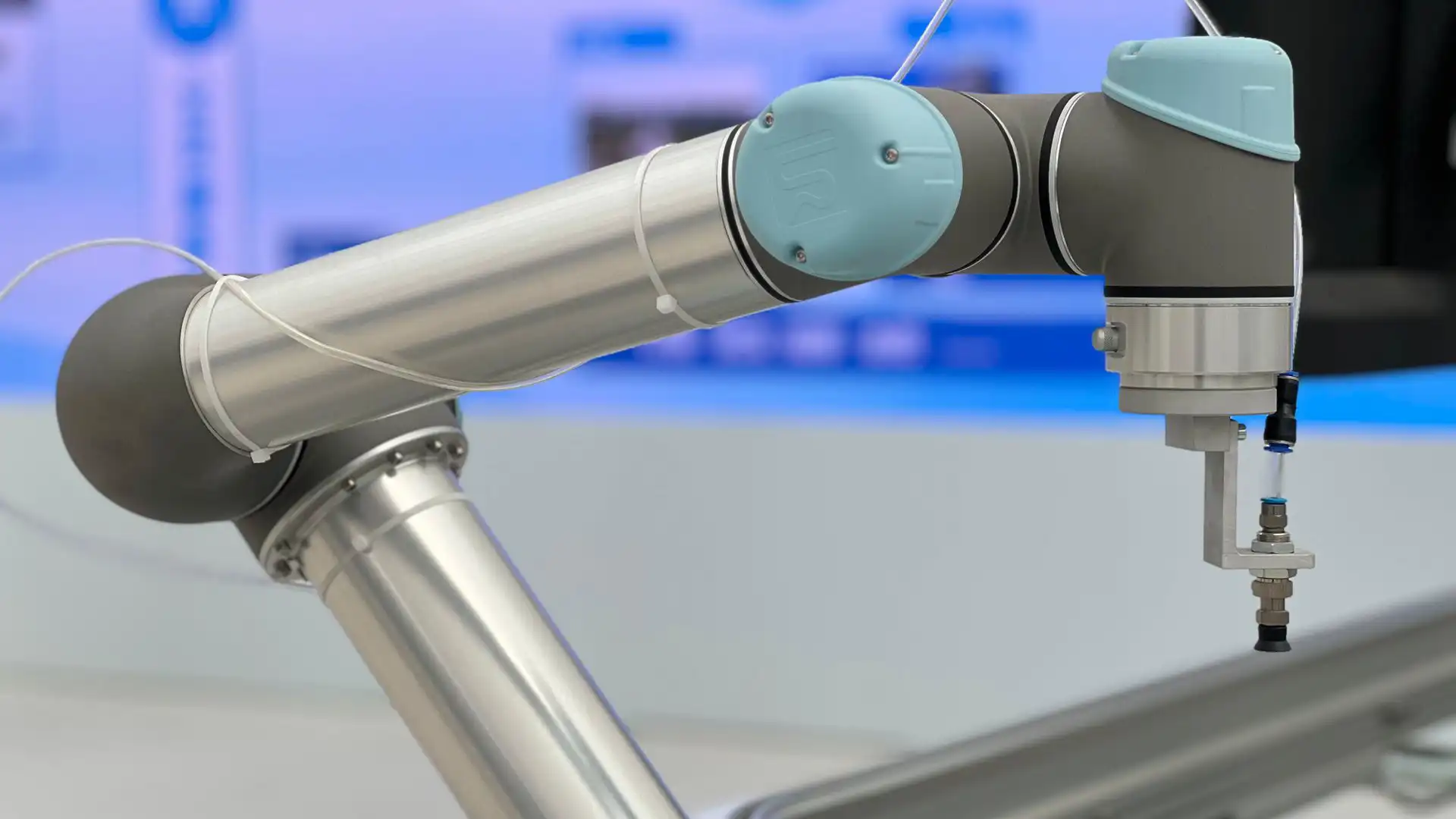
Engineering intelligent machines that improve industrial productivity.
Industrial, inspection and collaborative robots, and the software and manipulation research that makes them useful on a real factory floor.
Overview
A robot is a machine that senses its surroundings, decides what to do about them, and acts on the physical world. What separates one from a fixed automation cell is that decision step: the same arm becomes a different tool when it can perceive what is in front of it.
Robotics sits at the meeting point of mechanical design, embedded electronics, control theory and perception software. Vionexta works across all four, because a robot that fails does so at whichever of them was treated as someone else's problem.
Industry Challenges
Conventional industrial robots repeat a taught path precisely but cannot adapt when a part arrives misaligned, mixed or damaged.
Inspection in confined, hot or hazardous spaces still depends on sending a person, which limits how often it can be done.
Handling varied and deformable objects remains difficult, so material handling is automated only where the parts are uniform.
Integrating mechanics, electronics, control and vision is where most robotics projects lose time, because of diversified vendors.
Vionexta Approach
Develop robotic systems as whole engineering problems — mechanism, electronics, control and perception designed together rather than integrated afterwards.
Build perception into the control loop so a robot can respond to what is actually in front of it, not only to what was taught.
Prototype rapidly, test against real industrial conditions, and let validation results drive the next design iteration.
Target the tasks industries repeat most often and automate least well: inspection, material handling and constrained manipulation.
Research Areas
Robotic manipulation and grasping of varied objects
Vision-guided motion and closed-loop visual servoing
Autonomous mobile robots for indoor industrial environments
Safe collaborative operation alongside human workers
Robotics software architecture and real-time control
Applications
Automated visual inspection on production and assembly lines
Material handling and machine tending in manufacturing cells
Inspection of infrastructure and equipment in hazardous locations
Warehouse movement, picking and internal logistics
Collaborative assembly tasks shared with human operators
How the Work Is Done
The order matters: each step exists to settle something the next one depends on.
- 01
Characterise the cell before designing the machine
Reach, payload, cycle time, part variation and the tolerances the surrounding process actually holds are measured on site first. A robot sized against nominal parts fails on the day the line runs worn tooling, so the envelope is taken from the real distribution rather than the drawing.
- 02
Co-design mechanism, electronics and perception
Kinematics, actuation, sensing and the control loop are specified together. Mounting a camera after the arm geometry is fixed is what produces the occlusion problems that are then solved in software at ten times the cost.
- 03
Prototype the difficult motion first
The riskiest manipulation — the misaligned part, the deformable object, the confined approach — is built and attempted before the surrounding system exists. If that motion is not achievable, nothing downstream of it matters.
- 04
Test against the failure conditions, not the demo
Evaluation runs under changed lighting, varied part presentation, vibration and operator interference, and records where performance degrades rather than where it succeeds. The measured envelope is what the deployment is then scoped against.
Future Vision
Robots that are commissioned by describing the task rather than by teaching every point, shortening deployment from weeks to days.
General-purpose manipulation capable enough that a single platform serves several tasks in one plant.
Robotics as the physical layer of a wider industrial intelligence system, connected to the digital twin of the process it works in.
Relevant Industries
Manufacturing
Inspection, machine vision and process intelligence for plants where quality and throughput are limited by what cannot currently be measured.
Automotive
Inspection, robotics and embedded engineering for component and assembly operations where tolerance, traceability and cycle time all bind at once.
Textiles
Machine vision for fabric inspection and robotics for deformable material handling, applied to spinning, weaving, knitting and garment operations.
Logistics
Autonomous mobile robots, vision-guided picking and condition monitoring for warehousing and internal logistics operations.
Healthcare
Precision engineering, inspection and automation applied to medical device manufacture, laboratory workflows and hospital logistics.
Infrastructure
Inspection robotics and computer vision for structural assessment and condition monitoring across bridges, roads, buildings and utility networks.
Energy
Inspection robotics, sensing and predictive monitoring for generation, transmission and industrial energy infrastructure.
Future Aerospace
A prospective direction rather than current work — the precision engineering, embedded electronics and autonomy that aerospace applications would require.
Let's Build the Future Together.
Whether you are Industry, a Research Institution, a University, a Government Agency, a Technology Partner, an Investor or a Student — we welcome opportunities to collaborate and create technologies that shape tomorrow.