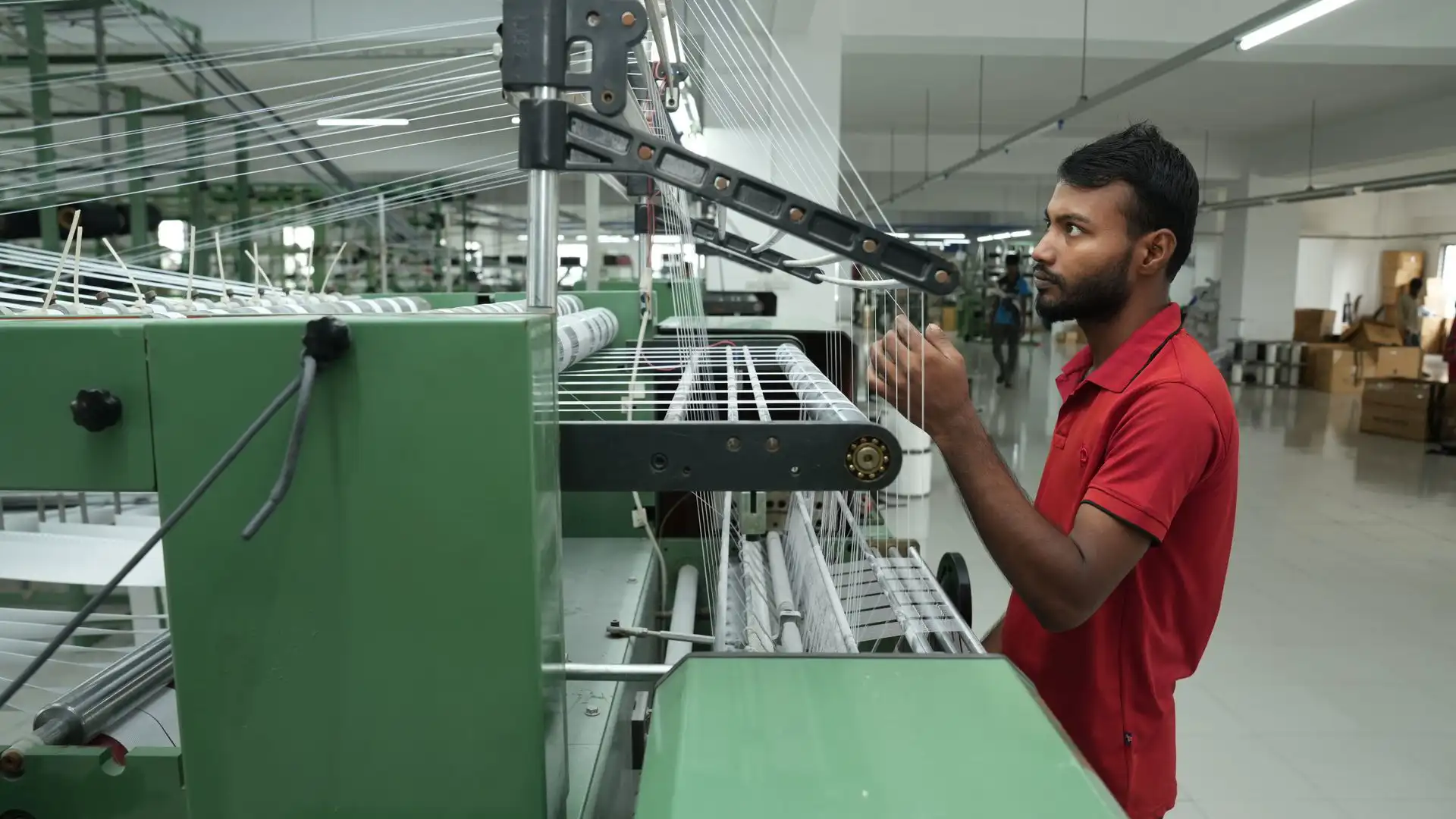
Inspection and handling for materials that will not hold their shape.
Machine vision for fabric inspection and robotics for deformable material handling, applied to spinning, weaving, knitting and garment operations.
Problem, Possibility, Method, Result.
The four questions this page answers about Textiles, in the order it answers them.
Industry Challenges
Fabric inspection is still largely visual and human, and inspector agreement on borderline defects is lower than the tolerances the specification implies.
Fabric is deformable, so grippers and fixtures designed for rigid parts do not transfer — handling remains one of the least automated steps.
A defect introduced at spinning or weaving is often only discovered after several downstream operations have added cost to the piece.
Short runs and frequent style changes defeat automation designed around a single fabric or garment.
Technology Opportunities
Continuous vision-based inspection covers the full width and length of a roll rather than a sampled portion.
Perception makes handling tractable for materials whose shape changes as they are moved.
Linking loom and frame data to inspection results locates the source of a defect rather than only its presence.
Measurement of energy and material use per run supports reduction that is verified rather than assumed.
Vionexta Approach
- Begin with inspection, because it produces the measurement everything else depends on and its value is legible immediately.
- Treat deformable handling as a perception problem rather than a fixturing problem, and scope it to the operations where the geometry is bounded.
- Connect quality results back to the machine and the shift that produced them, so cause can be established rather than inferred.
- Keep changeover cost low, since style variety is the defining constraint of the sector rather than an exception to it.
Potential Outcomes
Full-width inspection rather than sampled checking
Defects traced to the operation that introduced them
Consistent grading independent of inspector and shift
Less material lost to defects found late
Relevant Technologies
Industrial Automation
Machine vision, quality inspection, predictive maintenance and digital manufacturing — the intelligence layer above PLC and SCADA infrastructure.
Artificial Intelligence
Computer vision, machine learning, edge AI and decision support, developed as an enabling layer inside physical engineering systems.
Robotics
Industrial, inspection and collaborative robots, and the software and manipulation research that makes them useful on a real factory floor.
Future Possibilities
Looms and frames that adjust within set bounds when inspection detects drift.
Handling general enough to cover garment assembly steps that remain manual.
Mills where quality, energy and material data are held in one model rather than several.
Let's Build the Future Together.
Whether you are Industry, a Research Institution, a University, a Government Agency, a Technology Partner, an Investor or a Student — we welcome opportunities to collaborate and create technologies that shape tomorrow.