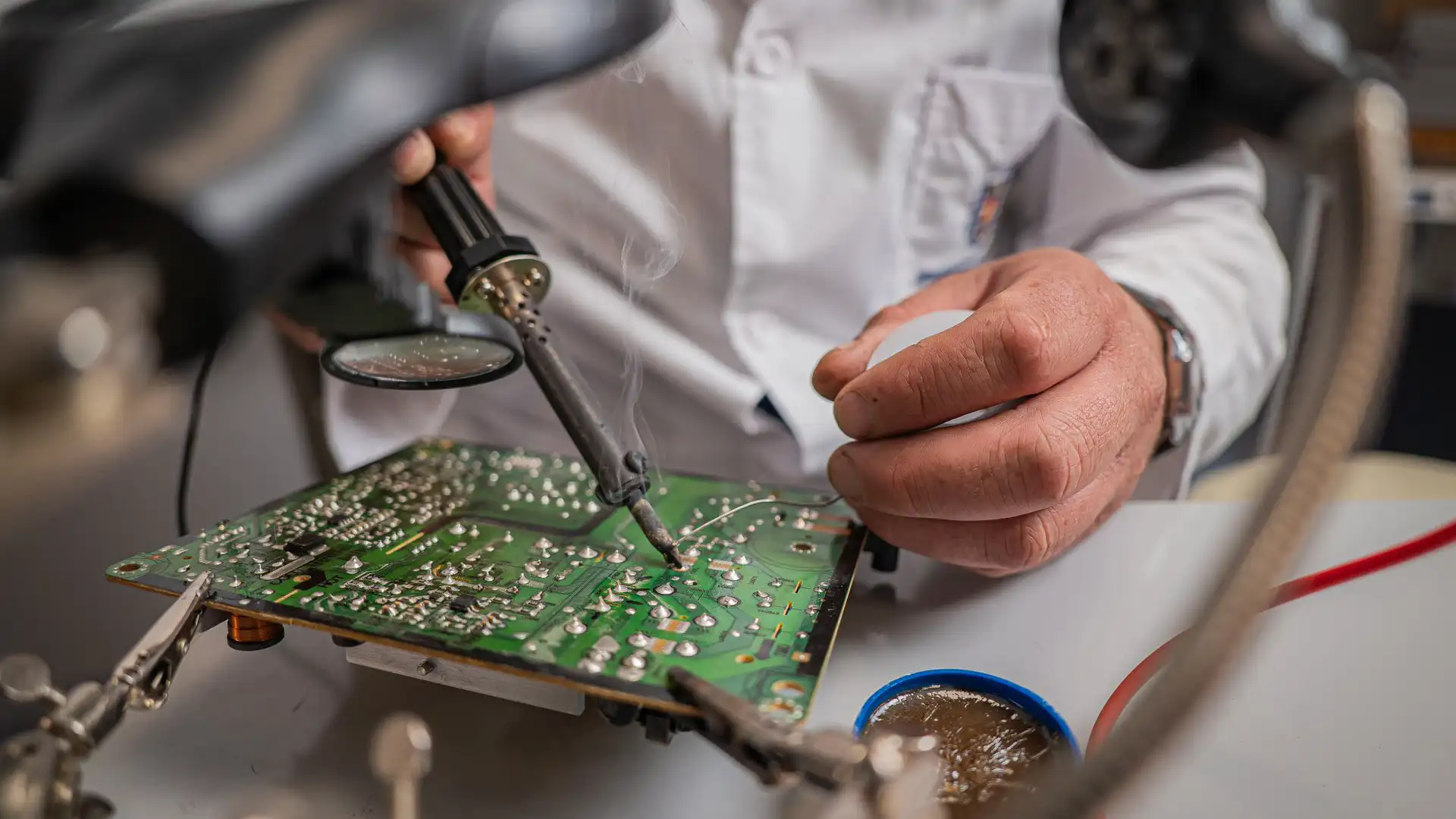
The electronics and firmware every intelligent machine stands on.
PCB design, sensors, embedded controllers, firmware and real-time systems — the hardware layer beneath robotics and industrial intelligence.
Overview
An embedded system is a computer built into a machine to do one job: read sensors, run a control loop, drive actuators, and meet its timing every cycle. It is judged on determinism and reliability rather than on throughput.
This is the layer everything else at Vionexta depends on. A robot's manipulation research and a factory's intelligence layer are both limited by whether the electronics underneath sample accurately, respond predictably and survive the environment they sit in.
Industry Challenges
Industrial environments impose electrical noise, vibration, temperature range and dust that laboratory electronics do not survive.
Real-time control has timing requirements that general-purpose operating systems do not guarantee.
Sensor data quality determines the ceiling on everything built above it, and calibration drift is easy to miss.
Component availability and lifecycle constrain designs that must remain serviceable for years.
Vionexta Approach
Design electronics and firmware together with the mechanical and control requirements, rather than to a specification handed over late.
Build for the deployment environment from the first revision — noise, thermal and vibration margins designed in, not discovered in testing.
Prototype quickly and iterate against measured behaviour on real hardware.
Treat sensing quality as a first-order design variable, because it bounds what perception and control can achieve.
Research Areas
PCB and power electronics design for industrial conditions
Sensor selection, conditioning and calibration
Real-time firmware and deterministic control loops
Embedded controllers for robotics and motion
Edge compute integration for on-device inference
Applications
Motor and motion control electronics for robotic systems
Sensor and data acquisition nodes for factory instrumentation
Embedded vision and edge inference hardware
Industrial control and interface electronics
Prototype electronics for research platforms and test rigs
How the Work Is Done
The order matters: each step exists to settle something the next one depends on.
- 01
Fix the power, thermal and timing budget first
Available power, dissipation headroom and the hard deadlines the system must meet are established before component selection. These constrain the design more tightly than processing capability does, and a budget discovered late usually means a board respin.
- 02
Co-design the hardware and the firmware
Schematic, PCB layout and firmware architecture are developed together, so that a signal-integrity problem is caught on the layout rather than worked around in code. Partitioning what runs on hardware and what runs in software is a design decision, not a default.
- 03
Bring the board up against instrumentation
First silicon is validated with test points, logic analysis and thermal measurement designed in from the start. A board that cannot be probed is a board whose faults are diagnosed by replacement.
- 04
Qualify against the operating environment
Temperature range, supply variation, electrical noise and mechanical vibration are tested to the limits the deployment will present. Embedded faults that only appear in the field are almost always the ones that were never tested for.
Future Vision
Reusable embedded platforms that shorten the path from a new mechanism to a working prototype.
Sensing and edge compute integrated closely enough that perception runs where the measurement is taken.
In-house electronics capability that gives Vionexta control over the parts of its systems that determine their limits.
Relevant Industries
Automotive
Inspection, robotics and embedded engineering for component and assembly operations where tolerance, traceability and cycle time all bind at once.
Healthcare
Precision engineering, inspection and automation applied to medical device manufacture, laboratory workflows and hospital logistics.
Infrastructure
Inspection robotics and computer vision for structural assessment and condition monitoring across bridges, roads, buildings and utility networks.
Energy
Inspection robotics, sensing and predictive monitoring for generation, transmission and industrial energy infrastructure.
Future Aerospace
A prospective direction rather than current work — the precision engineering, embedded electronics and autonomy that aerospace applications would require.
Nothing Written Yet.
We have not published an article on this domain yet. Everything we have written so far is in one place.
All insightsLet's Build the Future Together.
Whether you are Industry, a Research Institution, a University, a Government Agency, a Technology Partner, an Investor or a Student — we welcome opportunities to collaborate and create technologies that shape tomorrow.