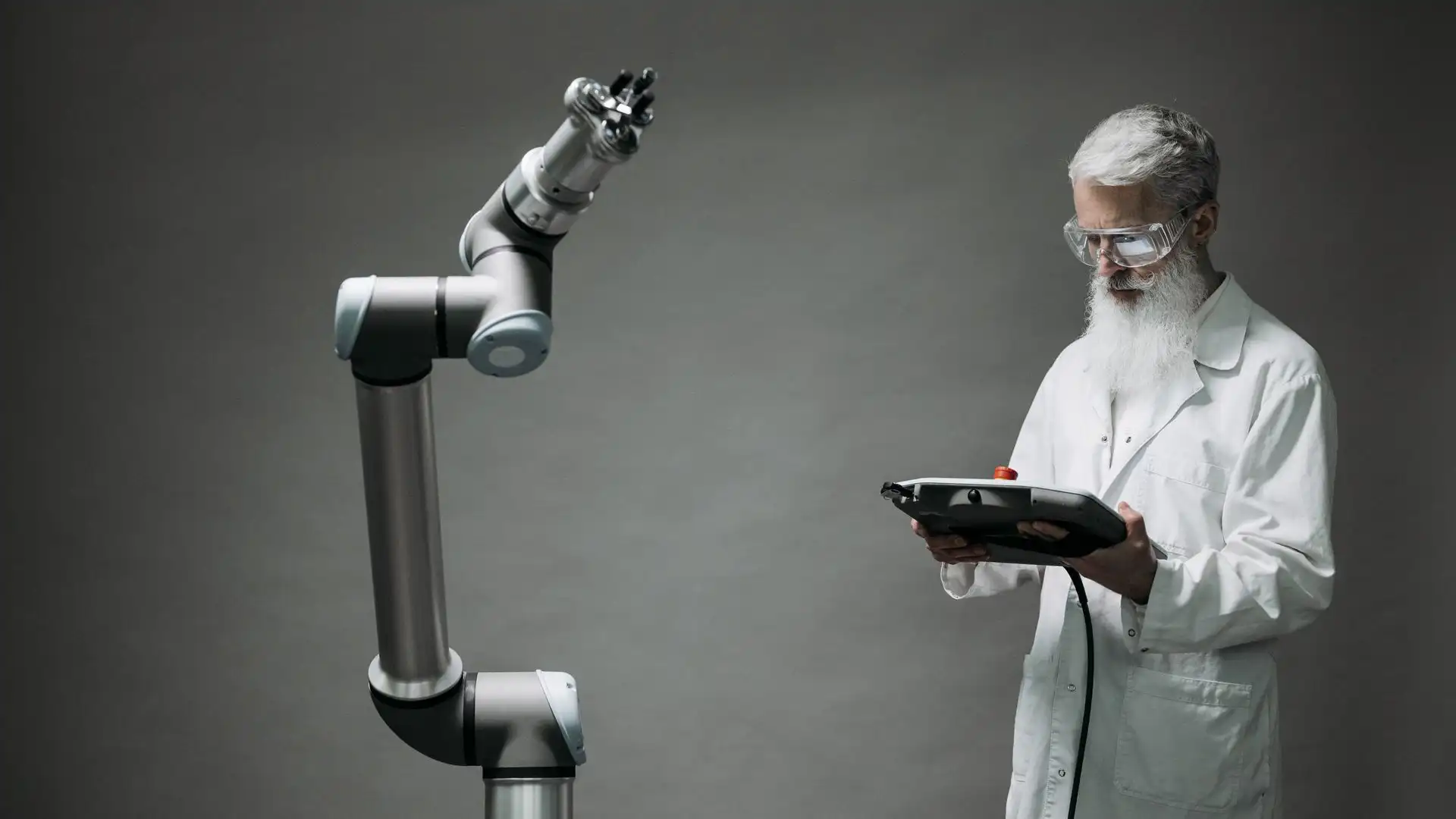
Researching machines that work in spaces built for people.
An early-stage research direction in dexterous manipulation, physical AI and perception — the groundwork for machines that share human environments.
Overview
Humanoid systems are machines shaped to operate in environments designed around the human body — stairs, doorways, hand tools, workbenches at hip height. The form is not the point; the point is that most of the built world already assumes it.
This is a research direction at Vionexta, not a product line. The work is in the capabilities a humanoid system would need — dexterous manipulation, whole-body perception, safe motion near people — each of which is useful on its own well before any complete machine exists.
Industry Challenges
Dexterous manipulation with multi-fingered hands remains an open research problem, particularly for objects a machine has not seen before.
Machines operating close to people must degrade safely under uncertainty, which conventional industrial safety cages sidestep rather than solve.
Perception has to work continuously across a whole body and a changing scene, not from one fixed camera position.
Energy, weight and actuation budgets constrain what a mobile human-scale machine can do for a useful length of time.
Vionexta Approach
Pursue the enabling capabilities individually — manipulation, perception, safe motion — so each produces usable engineering results independently of a complete humanoid.
Ground the research in industrial tasks Vionexta already works on, so progress is measured against real requirements rather than demonstrations.
Collaborate with academic research groups where the underlying problems are still open questions.
State clearly what is researched and what is built, and keep the distinction visible as the work develops.
Research Areas
Dexterous and multi-fingered manipulation
Physical AI — learned control of systems acting on the physical world
Whole-body perception and scene understanding
Safe human-machine collaboration and shared workspaces
Intelligent mobility over human-scale terrain
Applications
Potential future assistance with tasks in workplaces that cannot be re-engineered around fixed automation
Handling of varied objects in environments laid out for people
Inspection and intervention in spaces reachable only on foot
Support roles alongside human workers in manufacturing and logistics
How the Work Is Done
The order matters: each step exists to settle something the next one depends on.
- 01
State the research question before building anything
This is an early-stage direction, so the first step is to reduce an ambition to a question that a specific experiment could answer. Broad goals about human-shaped machines are decomposed until one dexterity or perception problem can be isolated and attempted.
- 02
Work in simulation until hardware would teach more
Contact-rich manipulation and balance are explored in simulation where an attempt costs seconds and breaks nothing. Simulation is trusted only for what it models honestly, so the point at which physical hardware becomes the faster teacher is decided in advance rather than by enthusiasm.
- 03
Define the safety envelope before shared space
Any system intended to operate near people has its force, speed and reach limits established, and its behaviour on sensor loss specified, before it is run alongside anyone. Predictable and legible behaviour is treated as a design requirement rather than a later addition.
- 04
Publish what did not work
Negative results are recorded and shared with collaborating groups. In a research direction this early, knowing which approaches have been eliminated is a substantial part of the value produced.
Future Vision
Machines that work usefully in unmodified human environments, rather than in cells built specially for them.
Manipulation general enough that new tasks are taught by demonstration instead of by re-engineering.
A path from individual research capabilities to integrated systems, taken in steps that each stand on their own.
Research, Not Yet Deployment.
This domain is a research direction rather than a deployed capability, so it is not yet applied in a named industry. The work appears in our research areas instead.
Research areasLet's Build the Future Together.
Whether you are Industry, a Research Institution, a University, a Government Agency, a Technology Partner, an Investor or a Student — we welcome opportunities to collaborate and create technologies that shape tomorrow.