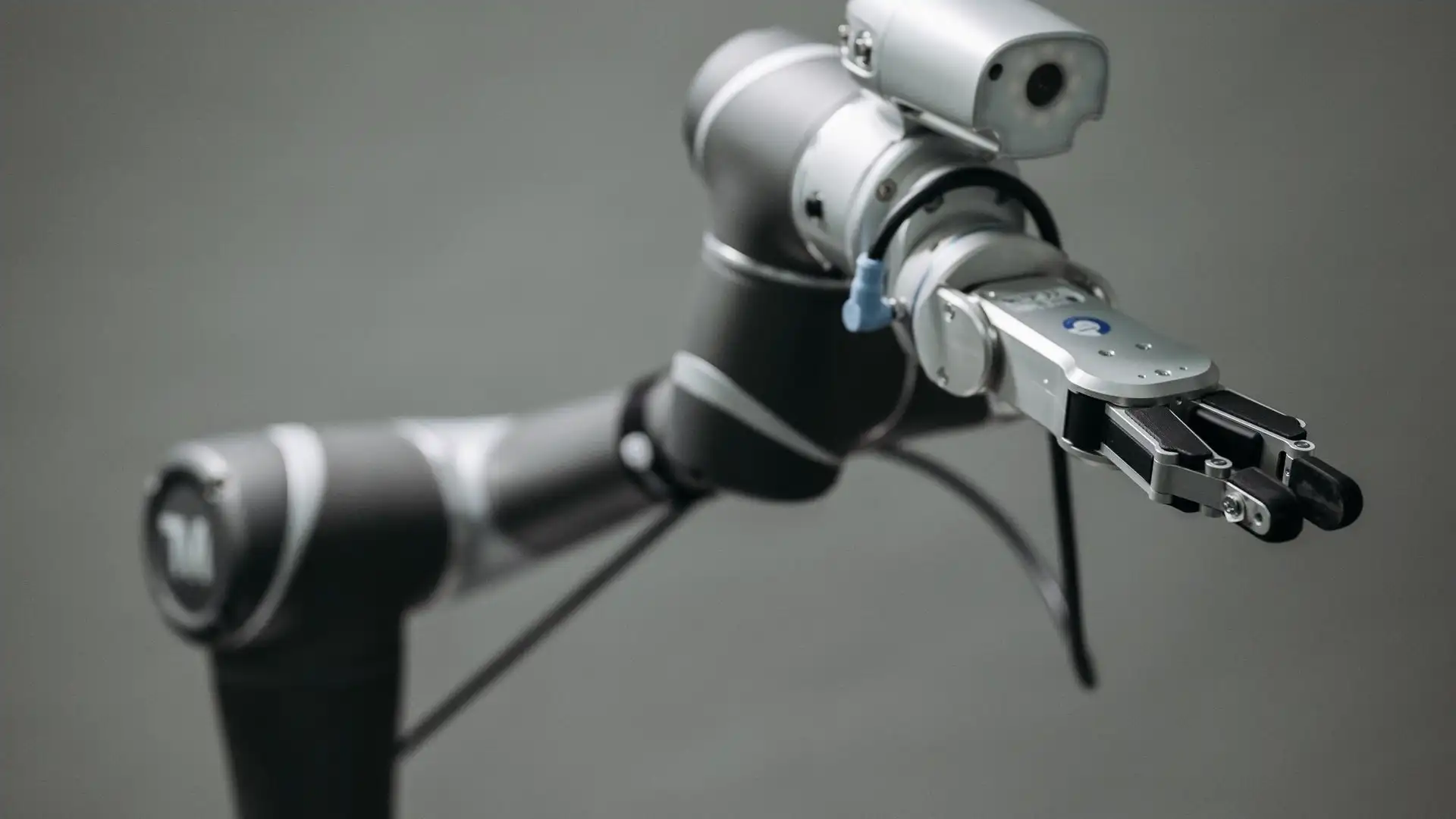
Intelligence that acts on machines, not only on data.
Computer vision, machine learning, edge AI and decision support, developed as an enabling layer inside physical engineering systems.
Overview
Artificial intelligence, in engineering terms, is the set of methods that let a system improve its behaviour from data rather than from explicit instructions. Computer vision interprets images, machine learning finds structure in measurements, and edge AI runs both close to the equipment producing them.
Vionexta treats AI as an enabling technology inside physical systems rather than as an offering of its own. A model matters here when it changes what a machine does — a robot that grasps a part it has not seen, an inspection station that catches a defect class nobody enumerated.
Industry Challenges
Industrial data is scarce, imbalanced and often unlabelled, so methods proven on public datasets transfer poorly.
Inference has to run within a control loop's timing budget, which rules out anything that depends on a round trip to a data centre.
Models that cannot explain a rejection are difficult to accept in a quality process that must be auditable.
Conditions on a factory floor drift — lighting, wear, supplier changes — and a model trained once degrades quietly.
Vionexta Approach
Select methods by the constraints of the physical system: latency, available data, and what happens when the model is wrong.
Run inference at the edge where the control loop requires it, and reserve heavier computation for offline analysis.
Design for monitoring from the start, so drift is detected rather than discovered through escaped defects.
Use AI to extend engineering work — inspection, prediction, decision support — instead of positioning it as a separate service.
Research Areas
Computer vision for inspection, guidance and scene understanding
Machine learning on limited and imbalanced industrial datasets
Edge AI and real-time inference under control-loop constraints
Physical AI — learned control of systems acting on the world
Predictive analytics and decision support for operations
Generative methods applied to engineering and design workflows
Applications
Defect detection and classification in visual quality inspection
Vision-guided robotic picking and placement
Failure prediction from equipment telemetry
Process optimisation from historical and live production data
Engineering assistance in design exploration and documentation
How the Work Is Done
The order matters: each step exists to settle something the next one depends on.
- 01
Establish what a useful answer would have to do
The performance a model must reach to change a decision is fixed before any is trained, together with the cost of each kind of error. Accuracy without that threshold is a number that cannot be acted on.
- 02
Collect data from the setting it will run in
Training data is gathered under the lighting, wear, seasonality and operator variation of the actual site. A model validated on curated data and deployed into a plant is being evaluated for the first time in production.
- 03
Hold out the hard conditions deliberately
Evaluation splits are constructed to separate the cases the model will find difficult — rare defects, edge lighting, new part variants — rather than sampled at random, so reported performance describes the difficult case and not the average one.
- 04
Design for drift from the start
Monitoring and a retraining path are specified as part of the system, because the process the model was fitted to will change. A deployment without that plan degrades quietly and is usually noticed by its consequences.
Future Vision
Perception and learning treated as standard components of an industrial system, specified alongside sensors and actuators.
Models that adapt to a specific plant after deployment instead of being frozen at delivery.
Physical AI capable enough that machines handle variation which today requires a person to intervene.
Relevant Industries
Manufacturing
Inspection, machine vision and process intelligence for plants where quality and throughput are limited by what cannot currently be measured.
Textiles
Machine vision for fabric inspection and robotics for deformable material handling, applied to spinning, weaving, knitting and garment operations.
Logistics
Autonomous mobile robots, vision-guided picking and condition monitoring for warehousing and internal logistics operations.
Healthcare
Precision engineering, inspection and automation applied to medical device manufacture, laboratory workflows and hospital logistics.
Infrastructure
Inspection robotics and computer vision for structural assessment and condition monitoring across bridges, roads, buildings and utility networks.
Future Aerospace
A prospective direction rather than current work — the precision engineering, embedded electronics and autonomy that aerospace applications would require.
Let's Build the Future Together.
Whether you are Industry, a Research Institution, a University, a Government Agency, a Technology Partner, an Investor or a Student — we welcome opportunities to collaborate and create technologies that shape tomorrow.