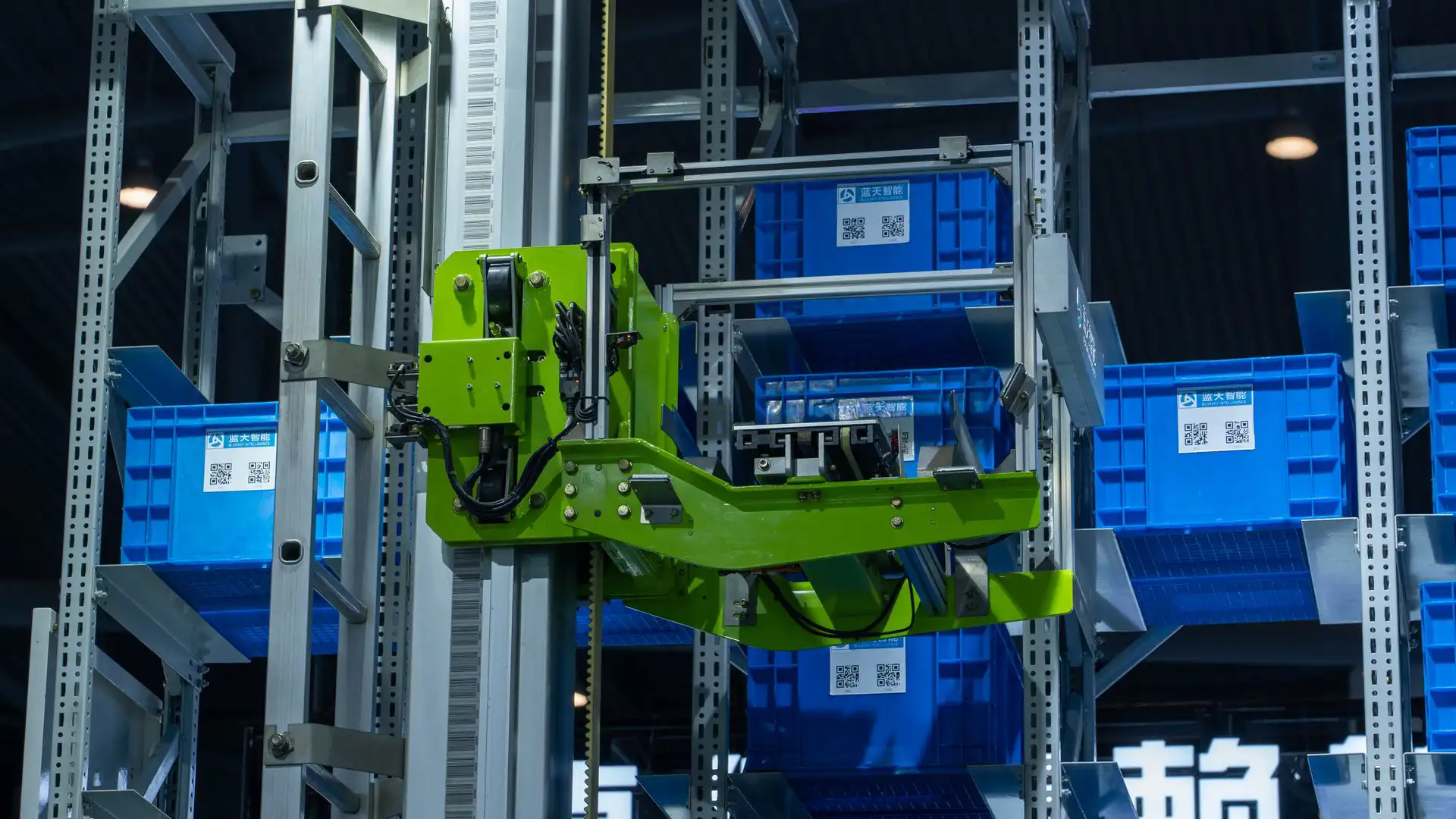
Movement, handling and inspection inside the warehouse.
Autonomous mobile robots, vision-guided picking and condition monitoring for warehousing and internal logistics operations.
Problem, Possibility, Method, Result.
The four questions this page answers about Logistics, in the order it answers them.
Industry Challenges
Labour availability constrains throughput more than floor space does in many operations.
Item variety defeats grippers and sortation designed around uniform packaging.
Inventory records and physical stock diverge, and reconciling them is manual.
Peak demand requires capacity that sits idle for most of the year.
Technology Opportunities
Autonomous mobile robots move goods without the fixed conveyor infrastructure that locks in a layout.
Vision-guided picking extends automation to mixed and irregular items.
Continuous scanning keeps inventory records aligned with physical stock.
Robotic capacity can be added incrementally rather than as one fixed installation.
Vionexta Approach
- Map the actual movement patterns before proposing equipment, since the bottleneck is often not where it is assumed to be.
- Deploy mobile robots on well-understood routes first and extend coverage from measured results.
- Apply perception to the handling tasks that item variety currently blocks.
- Keep the layout changeable — automation that fixes a floor plan ages badly.
Warehousing
Warehousing is where most of this work applies first. Storage, retrieval, sortation and dispatch are the operations where item variety, labour availability and peak demand collide most directly, and where the gap between what the inventory system believes and what is physically on the shelf is widest.
The approach is the same as for logistics generally: measure the movement that actually happens before specifying equipment, deploy autonomous handling on routes that are already well understood, and extend perception to the picking and sortation tasks that item variety currently blocks.
What separates warehousing is the premium on keeping a layout changeable. Fixed conveyor and sortation infrastructure commits a building to one flow pattern, which ages badly as the product mix moves. Mobile robots and vision-guided handling keep that decision reversible.
Potential Outcomes
Material movement decoupled from labour availability
Automation extended to items that fixed sortation cannot handle
Inventory accuracy maintained continuously rather than by periodic count
Capacity scaled in steps that match demand
Relevant Technologies
Robotics
Industrial, inspection and collaborative robots, and the software and manipulation research that makes them useful on a real factory floor.
Artificial Intelligence
Computer vision, machine learning, edge AI and decision support, developed as an enabling layer inside physical engineering systems.
Industrial Automation
Machine vision, quality inspection, predictive maintenance and digital manufacturing — the intelligence layer above PLC and SCADA infrastructure.
Future Possibilities
Fleets that re-plan routes as demand shifts through the day.
Picking general enough to handle new items without reconfiguration.
Warehouses whose layout is optimised continuously from observed movement.
Let's Build the Future Together.
Whether you are Industry, a Research Institution, a University, a Government Agency, a Technology Partner, an Investor or a Student — we welcome opportunities to collaborate and create technologies that shape tomorrow.